 By theo
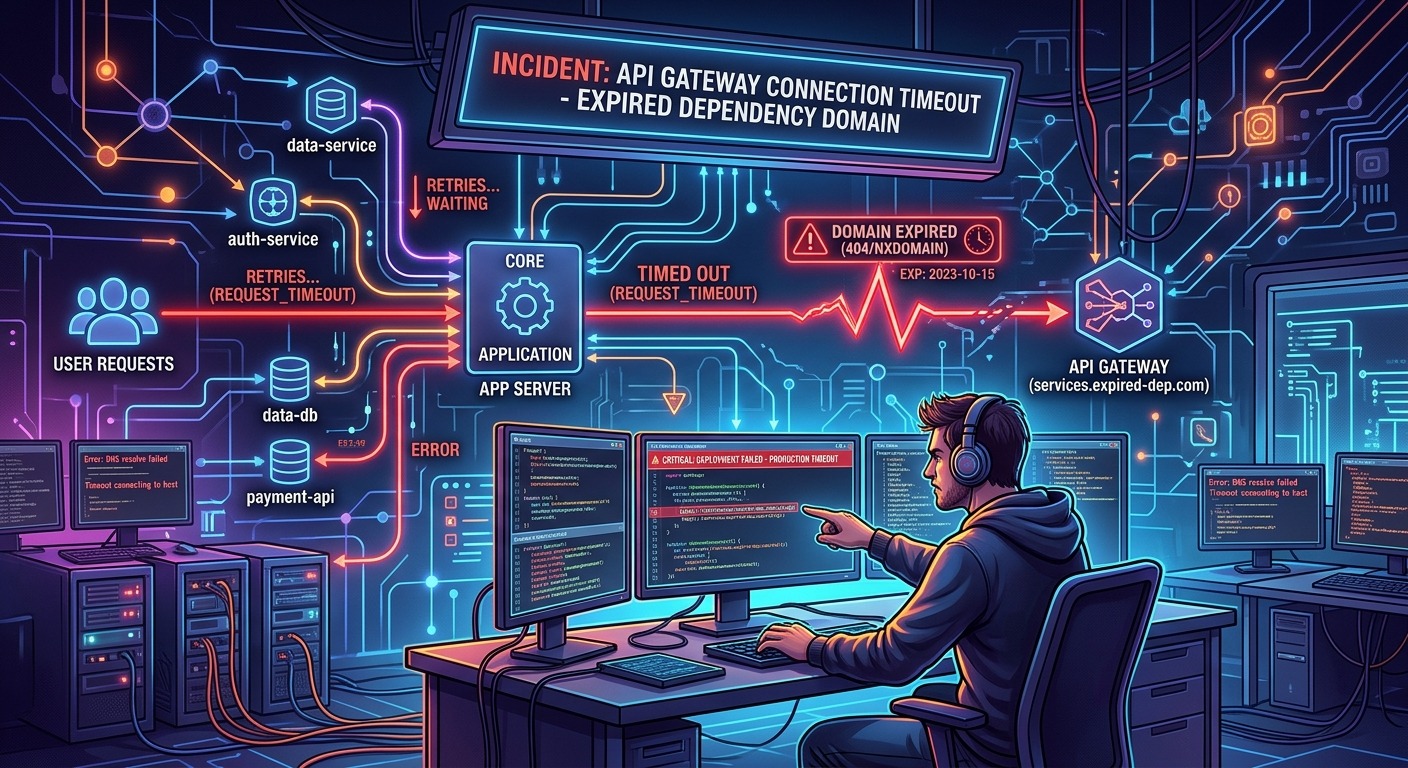
Your backend p99 jumps from 280 milliseconds to eight seconds. CPU barely moves. Database queries look healthy. Customers keep refreshing checkout, which is generous of them, because your service is already generating plenty of extra traffic itself. The slow requests all touch one third-party API. Its domain registration expired, DNS resolution started failing, and your retry policy turned a broken dependency into a capacity problem.
The Incident in One Paragraph: An expired dependency domain can surface as backend latency long before anyone recognizes a registration problem. Start with traces to locate the waiting, then inspect DNS from the affected runtime. Use registration records to test the expiration hypothesis, while accounting for caching and incomplete records. Contain the damage with a shared request deadline, bounded retries, and concurrency limits. Recovery requires both restored name resolution and evidence that queued work has drained.
The Latency Spike Starts With Waiting
Consider a representative incident. Checkout calls a shipping service before returning a price. The integration normally finishes in 90 milliseconds. It has a two-second attempt timeout and allows three retries. Nobody objects during review because two seconds sounds modest. Four attempts can consume roughly eight seconds before backoff and local queueing enter the picture.
At 14:07 UTC, shipping calls begin failing during hostname resolution. Existing requests occupy application concurrency slots. New requests wait behind them. The database remains fast because many handlers never reach their next query.
The first useful question is not whether the backend needs more replicas. It is where the request spends its elapsed time. More replicas might add capacity, but they can also multiply failed dependency attempts. A larger fleet is an expensive way to ask a dead domain the same question.
Treat this as an illustrative incident, with timings you can replace using your own telemetry. The investigative sequence matters more than the particular numbers.
Read the Trace as a Timeline of Attempts
Open a slow request and compare it with a healthy request for the same route. Locate the shipping operation. Check whether it contains several attempts, one long client span, or a gap before the outbound operation starts.
Those patterns point to different problems. Repeated child spans suggest retries. A delay before an outbound span may represent connection-pool acquisition or an application queue. A long client span with no response status could cover DNS resolution, TCP connection setup, TLS negotiation, or several phases bundled together.
Instrumentation varies. An HTTP client span does not automatically expose a DNS phase. Some clients resolve names through a runtime cache. Others delegate resolution to the operating system. An exception labeled “connection failed” is a starting point, not a diagnosis.
Capture the destination hostname, attempt number, elapsed duration, exception type, remaining deadline, and whether a connection was reused. Keep hostnames in controlled telemetry fields rather than copying complete URLs with tokens into logs.
Next, compare affected hosts and instances. If unrelated outbound APIs remain healthy, a broad egress failure becomes less likely. If only newly started pods fail, older pods may still have usable DNS answers or established connections. That difference can make a domain problem look like a bad deployment.
Check DNS Where the Application Actually Runs
A successful lookup from your laptop does not clear the dependency. Your laptop and production may use different recursive resolvers, caches, network paths, and search configuration. Run the first checks inside an affected container or an equivalent diagnostic environment on the same network.
Record the resolver address, response status, answer records, authority section, and TTLs. Preserve timestamps. DNS evidence without a time is awkward to compare with traces, especially during recovery.
NXDOMAIN means the queried name does not exist according to that response. SERVFAIL means resolution failed, which can involve delegation, DNSSEC validation, authoritative-server problems, or other causes. A timeout means you did not receive a usable reply within the waiting period. None of those outcomes alone proves that a registration expired.
An expired registration also does not guarantee immediate NXDOMAIN. Registry and registrar behavior varies. Delegation may persist for a period, disappear, or change to parking infrastructure. Cached records can keep some clients working while others fail. A parked address may resolve successfully but return the wrong certificate, an unexpected HTTP response, or a page your JSON parser strongly dislikes.
What Each Signal Can Establish
| Signal | Useful Evidence | Limit |
|---|---|---|
| Distributed trace | The dependency operation consumes the request budget across repeated attempts. | A broad client span may hide the precise network phase. |
| DNS query from production | The affected resolver returns an error, changed answer, or no reply. | One resolver’s view may differ from another cached view. |
| Registration record | Registration dates and domain status support an expiration investigation. | Dates and status fields do not establish current application reachability. |
| Dependency owner confirmation | The owner confirms a missed renewal and the restoration timeline. | Restoration still needs verification through production’s resolver and client. |
Use Registration Checks to Test the Expiration Hypothesis
Halfway through this investigation, you have a narrow suspect: the shipping hostname fails through production’s resolver, and its delegation appears to have changed. This is where registration evidence earns its place.
Consult the methodology behind a whois lookup as part of assessing how registration information is gathered and interpreted. For the incident itself, preserve the returned record, its source, the query time, expiration-related fields, and domain status values. Query the registrable domain that owns the API hostname. An API subdomain usually has no separate registration record.
Keep the limits explicit. Public records can omit information. Different services can expose different fields or refresh at different times. An expiration date in the past does not, by itself, prove that DNS stopped working at that instant. Grace periods and renewal processing complicate a simple date comparison.
The strongest diagnosis joins several observations: the domain owner confirms a missed renewal, registration evidence fits that account, DNS or delegation changed near the incident, and application traces show failures against that hostname. Without owner confirmation or adequate records, describe expiration as a supported hypothesis rather than a settled fact.
Retries Turn One Failure Into Shared Exhaustion
The domain failure explains the trigger. It does not explain why unrelated requests also became slow. Retry amplification does.
Suppose 120 incoming requests per second need shipping prices. Four total attempts per request can create up to 480 dependency attempts per second during sustained failure. The actual rate depends on concurrency limits, deadlines, backoff, and resolver behavior. Resolver caching may reduce upstream DNS queries, but it does not necessarily eliminate application attempts, timers, queued tasks, or occupied request slots.
Using a simple steady-state estimate, 120 requests per second spending eight seconds in the handler means roughly 960 requests in flight. That estimate assumes arrivals continue and the service can admit them. Real systems hit a limit somewhere. The resulting queue then becomes another source of latency.
Check every retry owner. An SDK may retry beneath your application wrapper. A service proxy may retry again. Four application attempts with three SDK attempts each can produce twelve lower-level attempts. Add client resubmissions, and the multiplication continues outside the trace you opened.
Count attempts at the layer where they actually occur. A setting named “three retries” usually means an initial attempt plus three more. That distinction is small in configuration and large during an outage.
Give the Dependency a Budget It Cannot Exceed
Start with an end-to-end deadline, then allocate part of it to the dependency. If checkout must finish within 1.5 seconds, a shipping integration cannot spend two seconds on each attempt. It has already lost before its first retry.
For an illustrative policy, give shipping 600 milliseconds total, including queue acquisition, resolution, connection setup, response reading, and any backoff. Permit at most two attempts, and start the second only if the remaining budget can support it. The exact values should come from your latency objective and observed dependency behavior.
Verify what your client actually times out. A socket read timeout may exclude DNS resolution. A connection timeout may exclude pool acquisition. An outer deadline is useful only if cancellation reaches the work underneath it. Abandoned background operations can keep consuming resources after the caller has returned.
Retry only failures that your operation can safely tolerate. A timeout does not prove the remote server rejected a write. Use idempotency protection where the API supports it. Persistent name-resolution failures are poor candidates for immediate repeated attempts within one user request.
Add jitter to eligible retries, enforce a shared retry budget, and limit concurrent calls to the dependency. A circuit breaker can reduce repeated work during sustained failure, provided recovery probes remain bounded. If shipping is mandatory, return a controlled failure promptly. If a cached quote is valid under explicit business rules, use it with its age checked.
Reproduce the Evidence With Bounded Commands
The commands below require Bash, dig, and curl. Replace the reserved example hostname with the affected API hostname. Use a documented read-only endpoint for the HTTP probe. Run from the affected environment, and retain the output with the incident timestamp.
export DEP_HOST='api.vendor.example'
export DEP_PATH='/health'

date -u '+%Y-%m-%dT%H:%M:%SZ'
cat /etc/resolv.conf

dig "$DEP_HOST" A +time=2 +tries=1
dig "$DEP_HOST" AAAA +time=2 +tries=1
dig "$DEP_HOST" CNAME +time=2 +tries=1

curl --silent --show-error --output /dev/null \
  --connect-timeout 2 \
  --max-time 5 \
  --retry 0 \
  --write-out 'dns=%{time_namelookup} connect=%{time_connect} tls=%{time_appconnect} first_byte=%{time_starttransfer} total=%{time_total} status=%{http_code}\n' \
  "https://${DEP_HOST}${DEP_PATH}"
printf 'curl_exit=%s\n' "$?"
The curl values are cumulative timestamps from the start of the transfer, not separate phase durations. A failed transfer may leave later values at zero. Read them alongside the error message and exit status. Also check proxy settings: when a proxy resolves the destination, this probe may exercise a different resolution path.
Compare the configured resolver with an approved alternate resolver only if production network policy permits it. For delegation analysis, run the following from a diagnostic host that permits direct DNS queries:
dig +trace "$DEP_HOST" A +time=2 +tries=1A trace performs iterative DNS queries. It does not reproduce your recursive resolver’s cache or the application’s DNS behavior. Restricted egress can prevent it from completing. Treat it as delegation evidence, then return to the resolver your application actually uses.
Repeat the same bounded probes after restoration. Confirm expected addresses, certificate validity, and the endpoint’s expected response. A successful DNS answer is only one recovery milestone.
Keep the Next Expired Domain From Owning Your Request Budget
Monitor critical dependencies from the same network context as the service. Measure DNS outcomes, connection failures, total operation latency, attempts per request, and dependency concurrency. Alert when retries rise while successful calls fall. That combination can expose amplification before the primary latency alert becomes a customer report.
Track registration status where useful, but pair it with functional probes. A renewed domain can still have broken delegation. A resolving hostname can still point to the wrong service. For domains your organization controls, assign renewal ownership and verify payment and recovery contacts. For vendor domains, maintain an escalation contact and a tested failure policy.
Before closing the incident, verify that queues drained, concurrency returned to normal, and retry volume settled. Test the failure path with controlled DNS errors and delayed responses in a safe environment. Assert that the total deadline holds and attempts remain bounded.
The third party owns its renewal mistake. Your service owns how much of that mistake reaches your users. A dead dependency should consume a small, deliberate budget, then release the request.